Click Chat
When I was locking myself up in my room to chat with people online in the 90s, I didn’t have Discord, Telegram, WhatsApp, Messenger, Instagram, or Twitter. None of them existed yet.
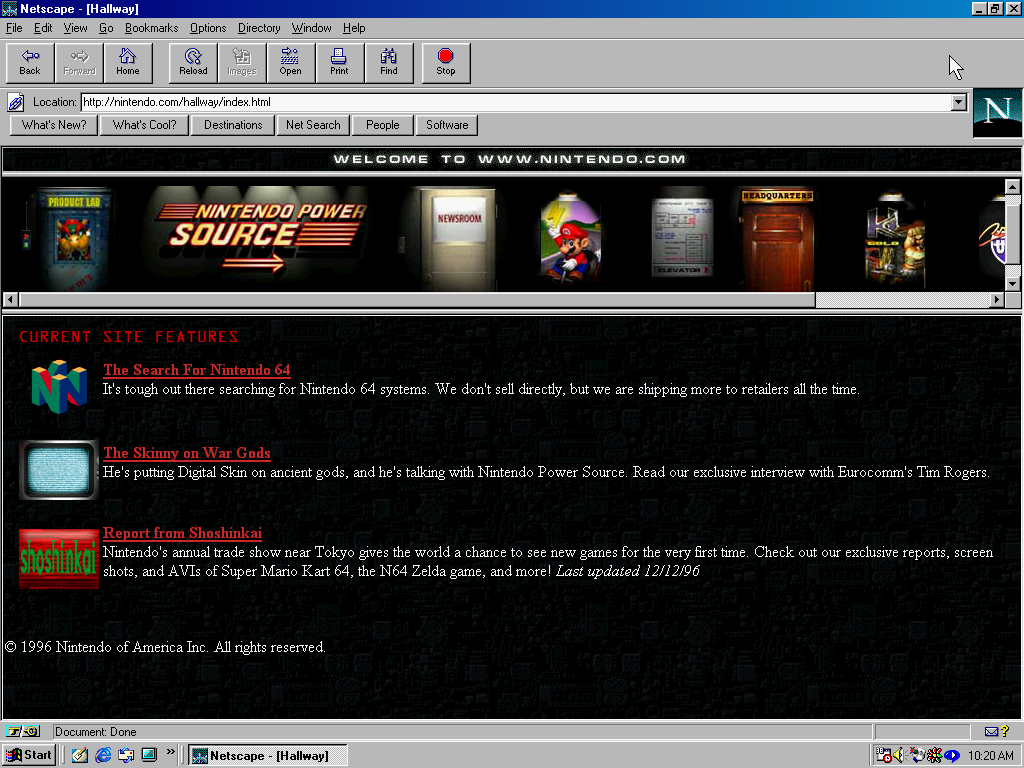
The first online chat rooms I visited frequently were on the Web. Although primitive in the 90s, a few sites had a place for people to chat. Being a big fan of Mario games, the first website I ever visited was nintendo.com. Believe it or not, back in 1995, it had an unmonitored chat rooms where random Nintendo players got together to talk about games and whatever they felt talking about.
Funny enough, in that time, I didn’t even know how a chat room worked. On my first day in there, I went by the default username, “anonymous.” Someone pointed it out—I didn’t even realise they were talking to me at fist—then I picked something generic like “NinGamer.” I know, wow… so creative… ;)
The security flaws on there were crazy in that time. Users could insert all the HTML code they wanted! It didn’t take long for a few of them to make the chat unusable by shoving a <plaintext> tag in a message, making the browser render the rest of the page in unusable code. (Good users were clever enough to find ways to help out and clear that tag!)
It didn’t take long for the chat room to be shut down. It was gone sometime within a year. As the Internet Archive started in 1996, sadly, they don’t have any archive of that chat. Back then, I did what I could to save all the contacts I made on there in a small text I’d save on a floppy disk. But yeah, of course everyone just scatterred away and I lost touch with everyone.
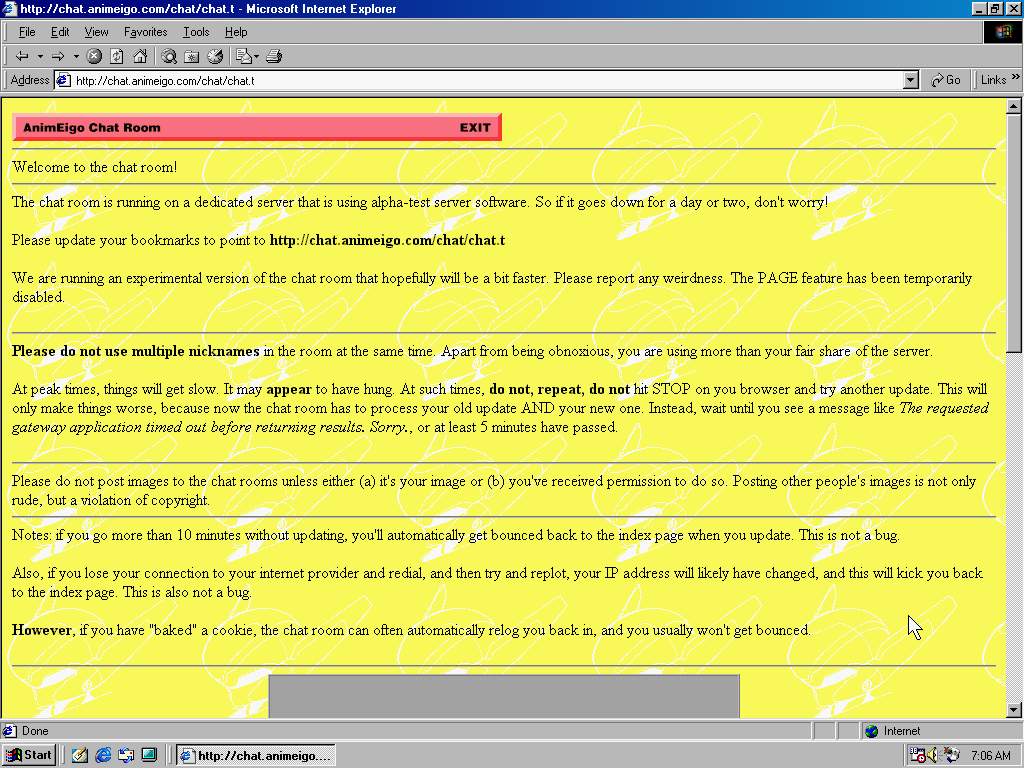
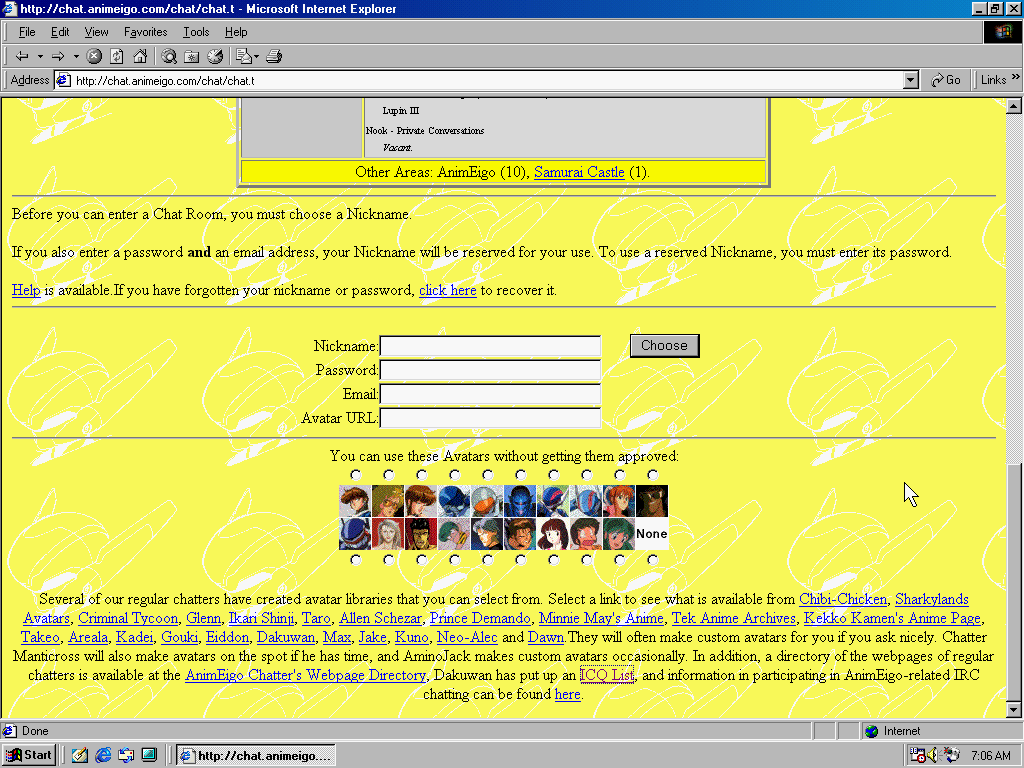
Then that meant I needed to find another go-to place. As a fan of anime back then, I landed in a chat room run by an American anime translation company, AnimEigo. Their “AnimEigo Chat,” with its iconic faded yellow background, was home to dozens of anime otaku, me included. AE Chat had more features: you could pick a colour for your name and a character avatar from AnimEigo anime titles. I can’t tell you how much I spoke about Sailor Moon on there, and how many hours I spent in their roleplaying channel.
Through AE, I even met a guy who sent me a copy of Neon Genesis Evangelion on VHS. I was happy to watch it and not miss out on that fresh new popular title in the time… then have my teenage years get perplexed by that series. I’ve met quite a few people on AE Chat, some of whom I’m still in touch today. Eventually, the chat was a drain on resources for the company hosting it, so it had to be taken down.
But unline the old Nintendo chat, years later, I was surprised to hear that a few AE refugees have made a Facebook group chat and Discord server to get us back together. Those spaces are not active, but at least it’s nice to see there’s a place where the AE chat spirit has a resting place. ^_^
(Thanks to Trebor, dedicated admin of the chat and employee of AnimEigo who worked hard to keep the server running for years—and, I believe, wrote the entire chat program in WebSiphon, an early page processor running on Macs back then, before the time of PHP. Also, wherever you are, thanks, “DV5”—if I remember the username correctly—for sending me those Evangelion tapes that helped shaped my knowledge of 90s anime!)
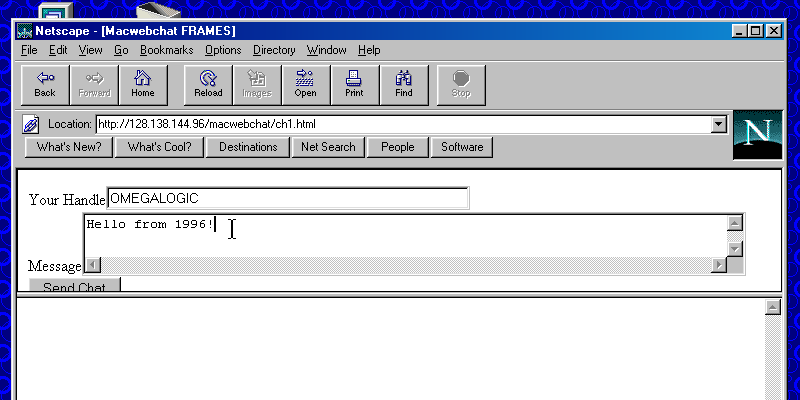
One of the odd random chatrooms I found back then was something called macwebchat (all in lower case). There were a few sites with that name looking the same. It was bare: no login, and a plain form asking for a “handle” and a message, and a frame reloading every few seconds to display the latest messages sent by everyone. No links, no About page. The place didn’t even have a domain name—just an IP address! The place looked soulless… until other users who stumbled upon the site like me joined in and brought it to life with our chit chat and virtual food fights. The chatroom was super basic, and yet, it was another place where I spent too many hours chatting. Given how hard the site was to find, it wasn’t crowded either—the place felt like a private cozy space in the corner of a lounge.

In any case, believe in or not, I did manage to connect with a few people on macwebchat. I had a penpal from Vancouver and I was chatting with her on there sometimes but then faded away. And there were two users in particular with whom I’m still in touch with today! We never saw each other in person, but for 30 years now, we witnessed each other grow at a distance—from high school using early blogging sites like LiveJournal, to now in our middle-aged life using Bluesky. How many connections have you made that lasted so long?
As to what the site was meant to be, I believe macwebchat was a programming demo part of a web server software package, but I never was able to find more details about it. That site is long gone now. But hey, if you want to try it, I made a recreation of macwebchat for the holidays which you can use right now! (It will become read-only after New Year’s.)

Another odd corner of the Internet I got myself into was some Japanese chatroom themed around Evangelion… But in the time, the multilingual support of my computer was rudimentary and so were my linguistic skills. I can’t even be sure as to how I even found those places. ^^;
Parallel to the Web, there were other chat programs sharing the limelight. And as there were no smartphones back then, and high-speed Internet wasn’t the norm in homes, I couldn’t just leave those programs on and forget about them before getting messages—I had to connect via dial-up first and be glued on my monitor.
I think the most common chat program in the day was mIRC on Windows. It allowed people to chat with others anywhere in the world via the vast IRC networks of servers. The IRC client was so common that people confused it with the platform, similarly to the tech illiterate confusing “the Web” and “Internet Explorer” as it still around today. (It also let you slap users with a large trout with its /slap command. ⟩<^,«⋗)
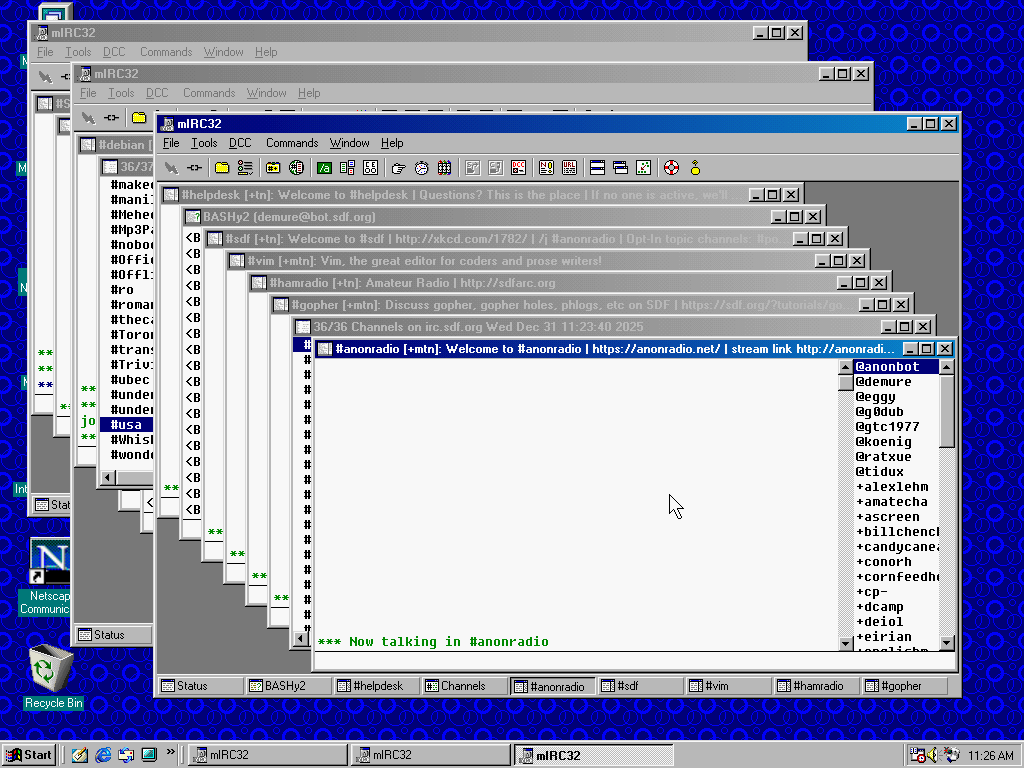
IRC had its flaws—many places didn’t have the ability to register usernames thus people could hijack yours at anytime you weren’t online, and the details of people’s connections, like their IP addresses, were leaked by design, which was exposing everyone’s PC to potential security risks.
Personally, despite the popularity of IRC, I merely fit in a few niche channels like #sailormoon and #evangelion where I chatted about their namesake anime series. Meanwhile, I downloaded JPEG and MIDI files from other channels, as IRC was famous for file distribution in the time.
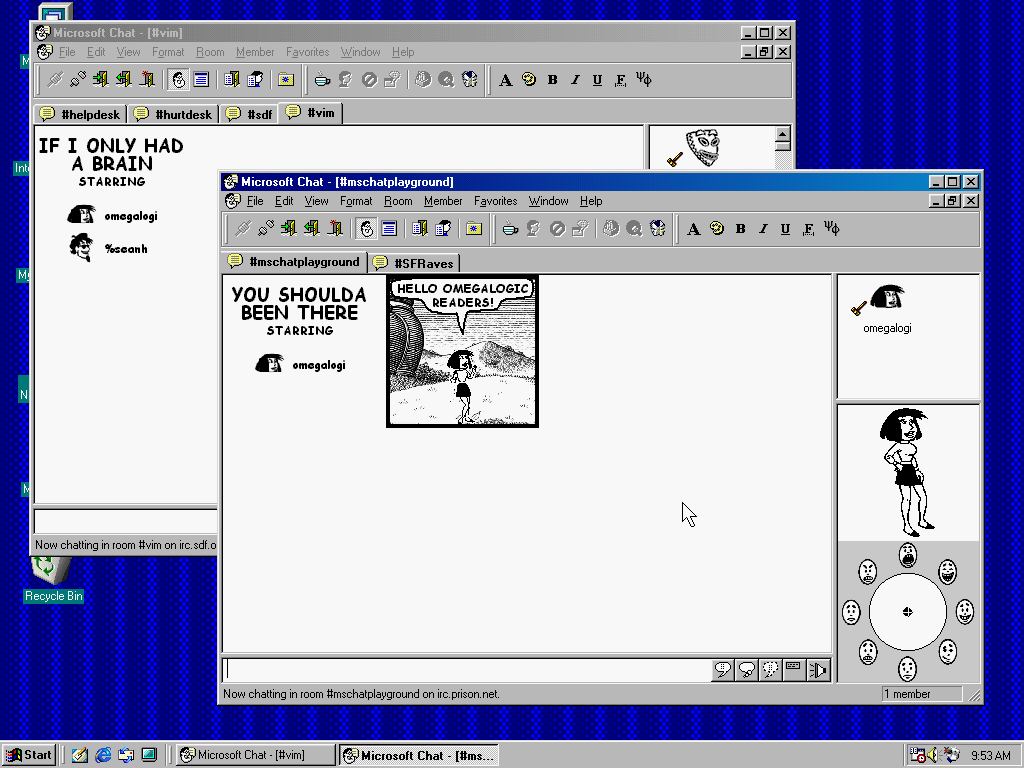
One odd chat program I had for a while was Microsoft NetMeeting, which was distributed with Internet Explorer 3 and 4 on Windows 95 and 98. When logging on the app, you were able to list yourself in a public directory for anyone to contact you while you were online. I found people in Japan on that platform and even chatted with a few, I remember. I had a microphone but no camera, although the people I spoke to had video. It was fun to be able to speak verbally to people far away, even with the low blocky quality and stuttering frame rate of the incoming video.
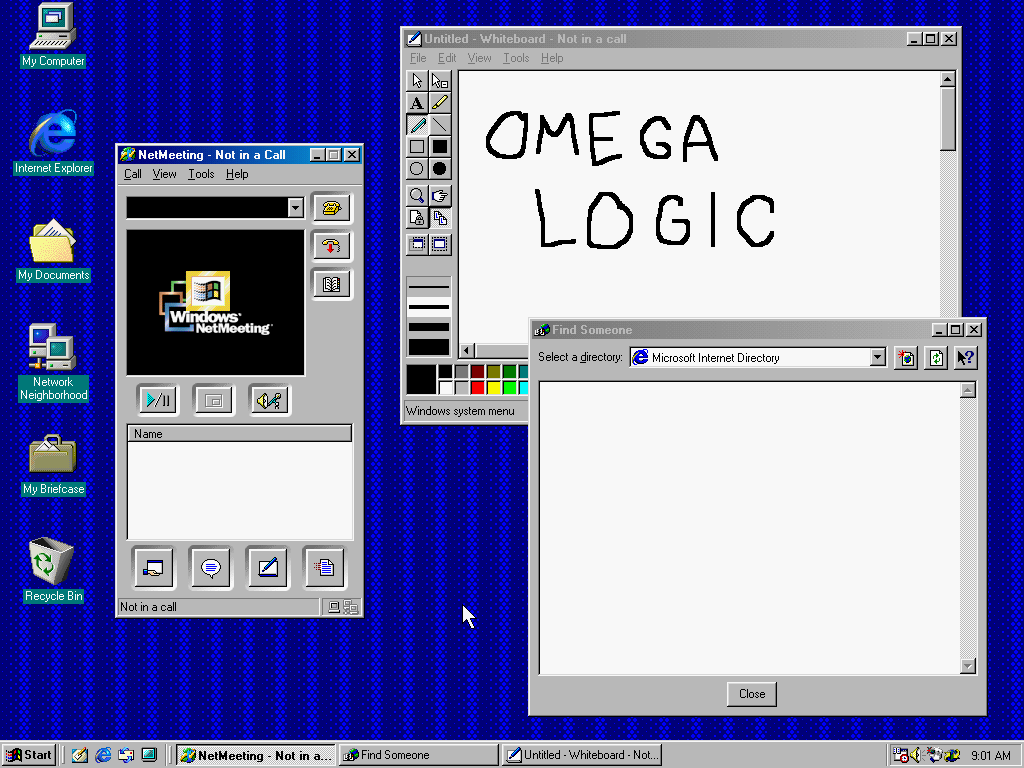
NetMeeting was mainly a business app, like an early iteration of Zoom, far ahead of its time, letting you share your desktop screen and a whiteboard. When speaking with people in Japan, we’d scribble Japanese on the whiteboard, while I was learning the language. I’d connect on the platform for sometimes an hour or two and make the most of it until one day, NetMeeting eventually lost its novelty and faded away like many programs of the day did.
Later in the 90s, always-on high-speed connection was gaining steam in people’s homes. That allowed for another type of chat program to gain popularity, the “instant messaging” apps. They allowed to cement an identity and point of contact online. Even if you were disconnected from the Internet, you still had your account on the platform, and it would queue up messages for you until you get back on, just like email. But unlike email, it alerted people when you were online and when you went offline.
ICQ, from “I Seek You,” was the first app of its kind and popular for shouting “uh oh!” every time you received a message. Instead of a username, every user had a UIN, a User Identification Number. Mine was 4080753, if you wanted to add me. But even if you did, it is now too late—the service left UINs behind years ago and the whole platform finally went offline for good in 2024.
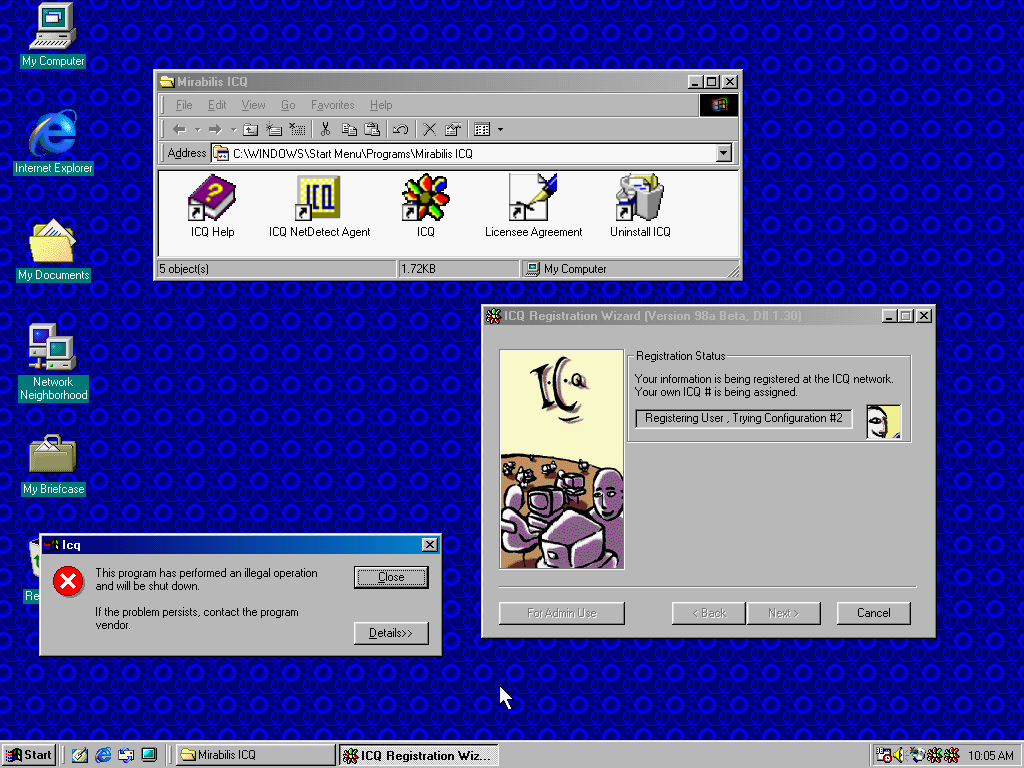
During the life of ICQ, AOL became its owner for a while and used the technology behind it to make their own instant messaging app, AOL Instant Messenger, or AOL IM, which I used briefly, yet not as much as ICQ.
Microsoft came along during its monopoly craze phase. They killed ICQ and AOL with their new MSN Messenger. The MSN brand itself may not have been the catchiest for many, but MSN Messenger quickly became the most popular IM app. I feel it was the first messaging app people started and left on all the time to always be online, even when their computer was still connected to the Internet but they were away from their keyboard. There was no need to disconnect and free up the phone line anymore—MSN Messenger was always on and ready to get your messages and show them to you when you got back.
Mentioning all these apps and platforms is somewhat nostalgic—my social skills basically grew up on those apps and platforms in the time. And yet, despite of all the new tools we have today, “the more things change, the more they stay the same.” We can see the influence of IRC in many chat platforms today, like Discord and Slack, using similar terminology like “direct messages,” “channels,” and “servers”—although IRC servers were normally different physical servers unlike today where the term is more synonymous with “community.” And today’s title of “Messenger” is held by Facebook.
Today, we take these apps for granted. They have more functionality, more polish. There is no more division between “instant messaging” and “chat room”. Everyone is always present, everywhere. Still today, even if connections may be more rare, I still manage to make new online friends, especially on Discord and Instagram. I wonder how chat apps will evolve from now and how we’ll act with each other 30 years from now…
Thanks for sticking to the end. As mentioned earlier, you too can experience Web chat rooms as they were in the late 1990s, with a script I wrote, hackwebchat. Come and say hi! (The chat will become read-only at the end of January 2026 or until I get too many notifications on my phone.)